Bruce Percy

Bruce Percy’s photography stands apart for its refusal to force the landscape into a fixed idea. His images emerge from openness, patience, and an instinctive response to elegance, tone, and form. What makes the work distinctive is its reduction: scenes are stripped back until they feel almost weightless, sometimes graphical, always emotionally charged. Rather than describing a place in full, he lets atmosphere and abstraction do the work, allowing the image to remain spacious and alive. That quality gives his photographs a rare clarity. They do not shout; they linger, and in doing so they invite a slower, more contemplative kind of looking.

Bruce Percy’s creative identity is grounded less in subject matter than in responsiveness. He resists defining himself by a fixed motif or predetermined category, preferring instead to remain open to whatever the landscape offers. This openness is central to the work. He does not go into the field looking to confirm an idea so much as to discover what moves him.

Over time, that approach has led him toward increasing reduction. Where he once thought in terms of objects within a scene, he now describes images in terms of their basic elements: luminosity, form, and color. This shift transformed his work. Rather than photographing scenery, he says he now photographs tonalities and form. The result is a body of images that often feels minimalist, abstracted, and sometimes almost graphical, while still remaining rooted in lived encounter with the land.

Music and visual art have been with him since childhood, and that broader creative background continues to inform the work. He sees himself first as a creative person, and photography as the medium that allows him to remain present and responsive. In this sense, the work is as much about attention and acceptance as it is about landscape.

Long familiarity with places such as the Bolivian altiplano also matters to him, not as a backdrop for quick results, but as an environment that slowly yields meaning. The photographs do not announce themselves as projects at the outset. They gather coherence gradually, through emotional response, editing, and time.

  • Official Website

    Website Bruce Percy 
  • Creative Context

    Edinburgh, Scotland

  • Photography Style

    Minimalist landscape photography focused on tonalities, form, atmosphere, and emotionally responsive compositions that often become graphical through simplification and abstraction.

  • Visual Themes

    Wilderness
    Atmosphere
    Tone
    Form
    Minimalism
    Abstraction
    Presence
    Emotional response
    Elegance
    Coherence
    Nature
    Creative freedom

Thoughts Behind the Work

"A good photograph is an honest one."

Photography Approach

Bruce Percy’s process begins without agenda. He prefers to arrive somewhere and respond emotionally rather than pre-visualize or direct the landscape toward a preconceived result. For him, photography is an exercise in submission: a way of living in the present moment and accepting what nature gives him. This attitude shapes both the making of the images and the pace at which they develop.

In the field, he is usually drawn first to something elegant or beautiful, though he often cannot say exactly what he is looking for until he finds it. The response is emotional rather than analytical. Later, through editing, patterns and themes begin to surface. He works from the bottom up, allowing the photographs to accumulate before their larger coherence becomes visible.

A crucial part of his approach is the reduction of the scene into tone, form, and color. As his understanding of photography changed, he moved away from seeing landscapes as collections of objects and toward seeing them as arrangements of tonal and formal relationships. That shift also made his work more abstract.

He is not driven by commercial pressure or rigid timelines. Some work resolves quickly; other bodies of work take years. His Bolivian altiplano photographs, for example, required repeated returns over eight years before he felt ready to make a book. A project ends only when he stops finding new things to do with it.

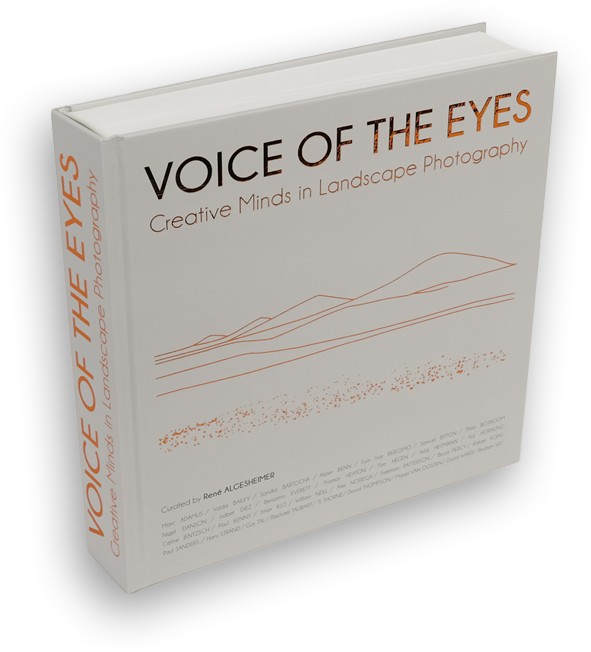
Inside Voice of the Eyes

Bruce Percy’s conversation reveals a photographer who places feeling before explanation. Readers quickly understand that his process is rooted in emotional response, and that he prefers not to over-intellectualize the act of making pictures while he is in the field. That in itself is revealing: the photographs begin not with certainty, but with sensitivity.

The interview also shows how profoundly his understanding of image-making changed over time. One of the most useful insights is his description of moving from photographing objects—trees, mountains, rivers—to photographing luminosity, form, and color. This shift helps explain both the minimalism of the work and its increasingly abstract quality.

Equally important is his attitude toward success, failure, and creative rhythm. He speaks with unusual clarity about photography’s ebb and flow, about the need to step back when things are not working, and about treating every stage as part of a longer process. Readers come away not just with a sense of how Bruce Percy photographs, but of how he lives with photography: as a way of being present, letting go, and remaining open to where the work wishes to lead.

Why Featured in Voice of the Eyes

Bruce Percy’s conversation reveals a photographer who places feeling before explanation. Readers quickly understand that his process is rooted in emotional response, and that he prefers not to over-intellectualize the act of making pictures while he is in the field. That in itself is revealing: the photographs begin not with certainty, but with sensitivity.

The interview also shows how profoundly his understanding of image-making changed over time. One of the most useful insights is his description of moving from photographing objects—trees, mountains, rivers—to photographing luminosity, form, and color. This shift helps explain both the minimalism of the work and its increasingly abstract quality.

Equally important is his attitude toward success, failure, and creative rhythm. He speaks with unusual clarity about photography’s ebb and flow, about the need to step back when things are not working, and about treating every stage as part of a longer process. Readers come away not just with a sense of how Bruce Percy photographs, but of how he lives with photography: as a way of being present, letting go, and remaining open to where the work wishes to lead.

Bruce Percy interview and landscape photography feature in Voice of the Eyes

Sample Question from the Interview

What’s your subject matter? Why?

I don’t think I have a subject matter. I just try to be open and respond to what the landscape
provides. Besides, I never know what I will like until I see it, and that could be many months later
when reviewing the transparencies. I like to keep things as open as I can. I try not to box myself
in too much.

Discover the Complete Interview with Bruce Percy

Frequently Asked Questions

Who is Bruce Percy?

Bruce Percy is a Scottish photographer based in Edinburgh who is known for minimalist landscape photography, photographic workshops, and monographs.

What characterizes Bruce Percy’s photography?

His work is characterized by minimalism, attention to tone and form, emotional responsiveness, and a willingness to abstract the landscape into simpler visual elements.

How does Bruce Percy approach photography in the field?

He prefers to respond emotionally to what the landscape provides rather than pre-visualize or work from a fixed agenda.

How has Bruce Percy’s visual style changed over time?

He moved from thinking in terms of objects within a scene to thinking in terms of luminosity, form, and color, which led his work toward greater abstraction.

Does Bruce Percy work on long-term projects?

He is not strongly project-based, but some bodies of work develop over many years, such as his work in the Bolivian altiplano, which took eight years before becoming a book.

What role does editing play in Bruce Percy’s work?

Editing is a long creative process for him, and it is often only at that stage that themes, patterns, and the larger purpose of the work begin to emerge.

What matters most to Bruce Percy in photography?

He emphasizes honesty, coherence, presence, and the ability to stay creatively engaged with the work over time.

Explore Voice of the Eyes

Discover interviews, creative perspectives and curated landscape photography from exceptional artists featured throughout Voice of the Eyes.

Explore the Book