Hans Strand

Hans Strand’s photography stands apart for the way it finds order inside complexity. His images are rarely content to describe a place at face value. Instead, they reveal the forces that shape a landscape, whether through braided rivers, eroded terrain, water, forest, or the visible marks of human intervention. Even when frozen in a still frame, the photographs continue to suggest movement, growth, and geological time. That combination of formal clarity and restless natural energy gives the work its particular force. It asks viewers not only to admire a landscape, but to read it.

A defining quality of Hans Strand’s work is his attraction to complexity. He is less interested in uncomplicated beauty than in landscapes that resist easy reading. Graphic formations, tangled structures, braided rivers, chaotic natural systems, and the marks left by geological or human forces all become material for his photographs. What matters is not simply what a place looks like, but how its internal order can be discovered through composition.

This gives his work a particular tension. He has said that chaos triggers a process in his mind through which he tries to create order, and that impulse remains central to his creative identity. His photographs often suggest that a landscape is not static but active, still carrying the energy of the processes that formed it.

Over time, his work has evolved away from what he once described as “hallelujah light” and more overtly dramatic grand views. He now concentrates more on intimate landscapes and aerials with interesting patterns and formations, often leaving out the sky entirely when it adds nothing to the image. This shift has made the work more distilled and more recognizably his own.

Another important dimension of his recent practice is the growing presence of human influence within the landscape. Agricultural forms, environmental pressure, water pollution, and altered ecosystems have become part of the work, adding another layer to images that were already concerned with time, movement, and change.

  • Official Website

    Website Hans Strand 
  • Creative Context

    Sweden

  • Photography Style

    Landscape photography defined by analytical composition, geometry, complex natural patterns, intimate landscapes, aerial perspectives, and images that express the forces shaping land over time.

  • Visual Themes

    Movement
    Time
    Growth
    Geological forces
    Complex landscapes
    Graphic patterns
    Water
    Forests
    Aerial landscapes
    Intimate landscapes
    Human influence on ecosystems
    Environmental change

Thoughts Behind the Work

"The wilderness is the mother of all living things. It is always true and never trivial."

Photography Approach

Hans Strand approaches photography analytically, but never mechanically. He begins with signals in the landscape itself: lines, figures, shapes, colors, and sometimes dramatic light. Yet light alone is never enough. What interests him most is how those elements can be organized inside the frame so that the image gains tension, life, and harmony.

Geometry and composition are central to his process. He has said that a good photograph is mostly about geometry and how it is organized within the frame, and that the corners of the image must work together. This attention to structure is what allows him to transform complex, chaotic subject matter into something coherent and personal.

He often works from an established concept. Topics such as water, forests, or human influence in the landscape may guide image-making over long periods, and these bodies of work often continue for years. Iceland, for example, has remained an open project for decades. He collects images until a book or exhibition begins to suggest itself, and a photograph belongs in a project only if it adds a new dimension to the subject.

Technical quality also matters deeply to him. He expects prints and books to withstand close scrutiny, believing that technical perfection helps the image communicate with the viewer more directly.

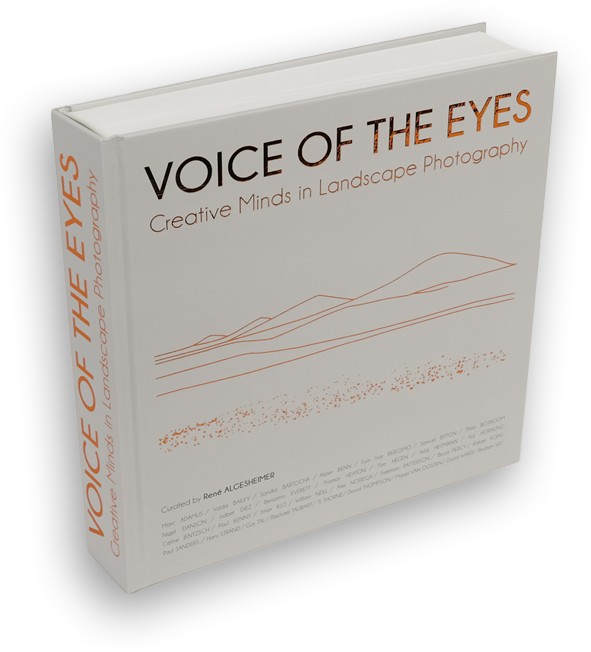
Inside Voice of the Eyes

Hans Strand’s conversation reveals a photographer for whom composition is not secondary to subject but the means through which subject becomes meaningful. Readers learn quickly that he does not approach landscape as a simple record of place. Instead, he is looking for forces, tensions, and patterns that can be organized into a coherent image.

One of the most valuable insights in the interview is his preference for complexity over beauty. He speaks openly about chaotic nature as something that stimulates him, because it demands that he find structure rather than merely admire surface appeal. This helps explain why his photographs often feel both analytical and alive.

The interview also clarifies the evolution of his work. He describes moving away from dramatic “hallelujah light” toward more intimate landscapes and aerials, and he identifies influences ranging from David Muench and Henri Cartier-Bresson to Edward Burtynsky. Taken together, these reflections show a photographer who has steadily refined his language while broadening its subject matter to include environmental and human-shaped landscapes as well as wilderness.

Why Featured in Voice of the Eyes

Hans Strand belongs in Voice of the Eyes because his work demonstrates how landscape photography can move beyond description and become a language of structure, force, and time. His images are immediately visual, yet they are also deeply interpretive. They show landscapes as living systems shaped by movement, geology, and human intervention.

His perspective strengthens the publication because he brings unusual clarity to the role of composition. He does not treat it as decoration or refinement, but as the very place where personal vision becomes visible. That makes his work especially resonant in a book concerned with how photographers truly see.

He also contributes an important bridge between wild and altered landscapes. By turning toward aerial views, intimate patterns, and environmental themes, he shows that a mature photographic practice can remain formally rigorous while taking on broader questions about land, change, and the future of ecosystems.

Hans Strand interview and landscape photography feature in Voice of the Eyes

Sample Question from the Interview

When you look back, what are the central characteristics making up an impactful body of work?

A strong and personal visual language. A viewer should be able to identify the photographer
by viewing his/her work. It is hard to describe exactly how this is coming out. It can be the way the
photographer composes, the color scale or the light.

Discover the Complete Interview with Hans Strand

Frequently Asked Questions

Who is Hans Strand?

Hans Strand is a Swedish landscape photographer born in 1955 in Marmaverken, Sweden, known for work that reveals order within complex landscapes.

What defines Hans Strand’s photography?

His photography is defined by geometry, analytical composition, graphic patterns, and an interest in showing the forces that shape and create landscapes.

How has Hans Strand’s work changed over time?

He moved away from dramatic grand views and “hallelujah light” toward intimate landscapes and aerial photographs with interesting patterns and formations.

What subjects does Hans Strand photograph?

He photographs both natural and manmade landscapes, often focusing on water, forests, aerial patterns, and human influence on ecosystems.

Does Hans Strand work on long-term projects?

Yes. He prefers long-term projects over several years, which allow him to develop a more mature interpretation of a subject.

Why is technical quality so important to Hans Strand?

He believes technical perfection makes it easier to communicate with the viewer and expects prints and books to withstand close scrutiny.

Does Hans Strand offer workshops?

Yes. He offers one-to-one workshops in aerial photography and ground-level landscape photography in Iceland, Sweden, and Spain.

Explore Voice of the Eyes

Discover interviews, creative perspectives and curated landscape photography from exceptional artists featured throughout Voice of the Eyes.

Explore the Book