Paul Kenny

Paul Kenny’s work occupies a rare space where experiment, material sensitivity, and long attention converge. Over decades, he has built a visual language that asks viewers to look more closely at what is easily overlooked: fragments from shorelines, scraps of fragile matter, subtle structures that suggest both landscape and idea. His images are immediately compelling, yet they resist quick consumption. Beauty, in his hands, is never decorative alone; it carries thought, transience, fragility, and scale. That tension between the seductive and the reflective is what makes his work distinctive, and why his photographs continue to feel so resonant.

At the center of Paul Kenny’s work is a sustained interest in how small, easily overlooked things can open onto much larger questions. He describes this as looking at the micro and thinking about the macro, and it remains one of the defining principles of his practice. Over more than fifty years, he has developed a body of work that asks how material fragments, marks, textures, and recurring forms can carry ideas about landscape, time, ecology, and human presence.

Two long-running strands are especially important. Seaworks is the name he gives to work made on or about shorelines, shaped by decades of engagement with coastal places. These images seek the awe-inspiring in what is easily passed by, while evoking fragility, beauty, transience, and the marks left by human activity on the remaining areas of wilderness. O Hanami, by contrast, draws on fragile and ephemeral materials gathered from his garden, pond, and the fields and hedgerows around his home, while maintaining related concerns and techniques.

His creative identity is also marked by continuous experimentation with photography itself. Across analog and digital processes, monochrome and color, conventional cameras, scanners, prints, lightboxes, and moving image, he has kept the medium active and open. Yet despite these changes, one ambition remains constant: that each work should be a beautiful, appealing, and thought-provoking object.

  • Official Website

    Website Paul Kenny 
  • Creative Context

    UK

  • Photography Style

    Experimental photographic art that looks at the micro while thinking about the macro, combining beauty, fragility, transience, and layered visual ideas through evolving photographic processes.

  • Visual Themes

    Micro and macro
    Fragility
    Beauty
    Transience
    Ecology
    Shorelines
    Wilderness
    Human traces in landscape
    Ephemeral materials
    Visual motifs
    Coherence and mood
    Photographic process

Thoughts Behind the Work

"I make images about the world around me; the medium I choose is photography.”"

Photography Approach

Paul Kenny approaches image-making as an evolving conversation between idea, process, and material. He does not begin with photography as a fixed method, but with the need to make images about the world around him. Over time, that has led him through major shifts in technique and production: from analog to digital, from monochrome to colour, from camera to scanner, from paper prints to lightboxes, and from still images to moving work.

In the field, what first prompts him is something that creates or consolidates an idea already active in his work. He often carries a small LUMIX camera and an iPhone as a kind of sketchbook, using them to test, gather, and process visual thoughts quickly. Yet the finished work is the result of longer development. He describes working with a toolkit of concepts and techniques that he constantly reuses, while remaining alert to new thoughts that may alter the direction of the work itself.

Projects often develop through exhibition frameworks. A few images may suggest a larger body, which is then expanded in the studio until the group feels coherent enough to present. For him, coherence depends on visual motifs, mood, and consistency of ideas. His long-term output is, in his own words, one continuous project, shaped by instinct, experimentation, and the careful refinement of thought through photographic means.

Inside Voice of the Eyes

Paul Kenny’s conversation offers a particularly rich account of photography as a medium that is never static. Readers learn not only how his work has changed over time, but how he understands change itself: as something built into the history of photography and into his own practice. One of the most revealing ideas in the interview is his refusal to put the medium before the message. He insists on making images about the world around him, with photography serving as the chosen means rather than the subject.

The interview also clarifies the structure of his thinking. He speaks about visual communication, about images that carry not only what an artist saw but also what they thought about what they saw. He explains the relationship between Seaworks and O Hanami, the value of recurring motifs, and the importance of finding complex ideas within seductive surfaces.

Equally valuable is his discussion of process: sketchbook cameras, exhibition deadlines, studio development, framing, lightboxes, and the move into moving image. Taken together, these reflections reveal a practice grounded in experimentation, coherence, and long attention, while showing how a photographic language can grow across decades without losing its central concerns.

Why Featured in Voice of the Eyes

Paul Kenny belongs in Voice of the Eyes because his work demonstrates how photography can remain both materially inventive and intellectually focused over a lifetime. His images do not rely on spectacle alone. They ask for slower looking, and they reward it by opening into questions of fragility, ecology, wilderness, scale, and the structures through which we make sense of the world.

His perspective is especially valuable because it joins artistic seriousness with formal experimentation. Over more than fifty years, he has continued to adapt to changes in photographic technology without abandoning the core concerns of his work. That continuity within change makes his contribution particularly relevant to a publication interested in how photographers see, think, and evolve.

He also offers a language for describing photographic intention with unusual clarity. Whether speaking about the micro and macro, about coherence in a body of work, or about the relationship between beauty and thought, he gives readers insight into a practice that is rigorous without becoming rigid. That combination makes his presence in the book both necessary and memorable.

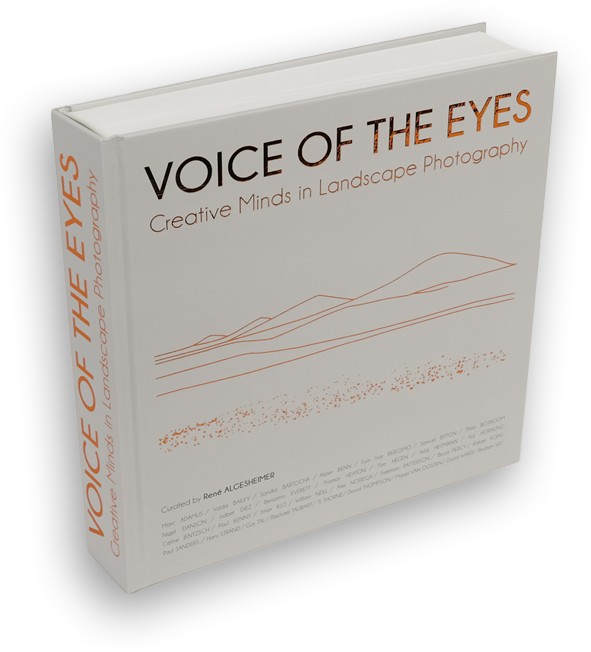
Paul Kenny interview and landscape photography feature in Voice of the Eyes

Sample Question from the Interview

When does your own photograph make you happy?

When I can create an image that is immediately beautiful and seductive but contains complex
thoughts and ideas that can slowly reveal themselves if the viewer works hard enough. When I
think I’ve achieved that, it makes me very happy.

Discover the Complete Interview with Paul Kenny

Frequently Asked Questions

Who is Paul Kenny?

Paul Kenny is a UK artist and photographer whose practice has developed over more than fifty years through continual experimentation with photographic processes.

What is Paul Kenny known for?

He is known for work that looks at the micro while thinking about the macro, especially through bodies of work such as Seaworks and O Hanami.

What is Seaworks?

Seaworks is Paul Kenny’s term for an ongoing body of work made on or about shorelines, exploring fragility, beauty, transience, ecology, and human traces in landscape.

What is O Hanami?

O Hanami is a separate body of work based on fragile and ephemeral materials gathered from his garden, pond, and the fields and hedgerows around his home.

How does Paul Kenny begin new work?

He works with a toolkit of recurring techniques and concepts, but new ideas often enter unexpectedly and are gradually incorporated into the work as it develops.

How does Paul Kenny define a good photograph?

For him, a good photograph contains not only what the artist saw, but also what they think about what they saw.

How does Paul Kenny present his work?

Presentation is a major part of his practice, ranging from traditional framed prints to Chromogenic Lambda prints on Fuji Crystal with LED backlighting, as well as moving image work.

Explore Voice of the Eyes

Discover interviews, creative perspectives and curated landscape photography from exceptional artists featured throughout Voice of the Eyes.

Explore the Book