Rafael Rojas

Rafael Rojas’s photography matters because it asks more of an image than beauty alone. His work is built to hold attention, then deepen it. Moving from visual appeal toward metaphor, emotion, and thought. Time, transience, mystery, and the unstable relationship between human life and the natural world run through his photographs, but never as illustration. Instead, he treats photography as a medium for inquiry, one capable of carrying concept and spirituality without losing its sensual force. That combination of intellectual grounding and visual ambiguity is what makes the work distinctive, and why it invites viewers not simply to look, but to linger.

Rafael Rojas’s creative identity is defined by an insistence that photography serve meaning rather than merely appearance. He describes the medium as a tool of personal expression and investigation, a way to explore what it means to be alive and to convey ideas, emotions, and questions that arise from that search. For this reason, his work is frequently anchored in concepts such as time, decay and renewal, the interaction between humans and nature, the fragile balance of the natural world, and the ephemeral qualities of existence.

A key aspect of his identity is the use of visual metaphor. He does not seek literal illustration, nor does he confine himself to one genre. Landscape, still life, animals, objects, constructions, and people can all become vehicles for the same deeper concerns. As he puts it, he is not a landscape photographer so much as a photographer of life.

His development has moved from more picturesque and dramatic treatments of the natural world toward increasingly metaphorical, project-based work. Over time, the expressive load of his images has shifted from the literal toward the universal, with time, transience, impermanence, memory, and environmental awareness becoming recurring foundations. Projects such as Timeless, The Pathos of Things, and Dead End show how these concerns can be translated through different subject matter while remaining coherent in intent.

Throughout, his work retains a strong intellectual grounding, but it is never purely cerebral. It is built to engage both conscious thought and subconscious response.

  • Official Website

    Website Rafael Rojas 
  • Creative Context

  • Photography Style

    Photographic art rooted in concept, emotion, spirituality, visual metaphor, and ambiguity, often shaped by simplification, mystery, black and white, and handmade platinum-palladium printing.

  • Visual Themes

    Time
    Decay and renewal
    Humans and nature
    Natural balance
    Latent energy in the landscape
    Ephemeral existence
    Transience
    Impermanence
    Memory
    Reality versus dream
    Environmental pressure
    Concept, emotion, and spirituality

Thoughts Behind the Work

"Photography for me is not the goal, but the means through which I can visually convey aspects of the world that fill me with emotions."

Photography Approach

Rafael Rojas works through two intertwined modes. At times he photographs intuitively, moving slowly and openly through a place, responding like what he calls a dilettante observer or artiste flâneur. In those moments, he favors contemplation, ambiguity, and the capacity of a subject to suggest more than it literally shows. He is often drawn to banal or anonymous places under ordinary light because they leave more room for personal expression.

At other times, he works within a clearer intellectual framework shaped by a project already in progress. He describes keeping mental drawers open at all times, ready to receive images that align with existing ideas. In these cases, decisions in the field are influenced by a project’s intent, emotional register, visual strategy, and even by how the work may later be processed, printed, sequenced, or presented.

His process continues decisively in the studio. Editing, sequencing, creating narrative, designing books, selecting materials, and printing are all treated as part of the expressive act. Books are especially central to his practice, and many projects evolve iteratively between field and studio. The work may split into new branches, generate further projects, or reveal gaps that send him back out again.

Printing is not secondary. He has devoted years to mastering platinum-palladium printing and regards the handmade print as a photographic object capable of embodying concept, emotion, and intent with exceptional subtlety.

Inside Voice of the Eyes

Rafael Rojas’s conversation reveals a photographer for whom images are inseparable from intention. Readers learn very quickly that photography, for him, is not an end in itself but a means of understanding the world, testing convictions, and translating personal inquiry into visual form. That gives the interview unusual depth from the outset.

One of the most valuable insights is his distinction between personal vision and visual style. He argues that style should remain a strategy chosen in service of meaning, not a ready-made template mistaken for authenticity. This clarifies much about his work: the variety of his projects does not come from inconsistency, but from a conscious adjustment of form to message, emotional connotation, and conceptual background.

The interview also makes his project practice legible. He explains how intuition and intellectual structure continuously interact, how books become crucial sites of meaning, and how editing, design, sequencing, printing, and presentation all shape the final expression. His reflections on time, transience, impermanence, and environmental concern further show that the work is grounded in more than observation. It is rooted in thought, memory, and a sustained desire to make photography capable of carrying universal significance.

Why Featured in Voice of the Eyes

Rafael Rojas belongs in Voice of the Eyes because his work exemplifies photography as a medium of thought, feeling, and sustained artistic inquiry. He does not treat the image as an isolated aesthetic event, but as part of a larger expressive system involving project, sequence, print, book, and context. That breadth makes his contribution especially important.

He also brings a rare articulation of how images can move from visual attraction to deeper significance. His reflections on intent, metaphor, ambiguity, and coherence help explain how photographs can carry concept, symbolism, and emotional force without becoming didactic. In a publication concerned with how photographers see, think, and shape meaning, that perspective is invaluable.

Finally, his work adds a strong philosophical and environmental dimension. Time, impermanence, memory, and the relationship between human activity and the natural world are not decorative themes in his practice; they are structural ones. That makes Rafael Rojas a significant presence in the book and a voice that expands what photographic art can do.

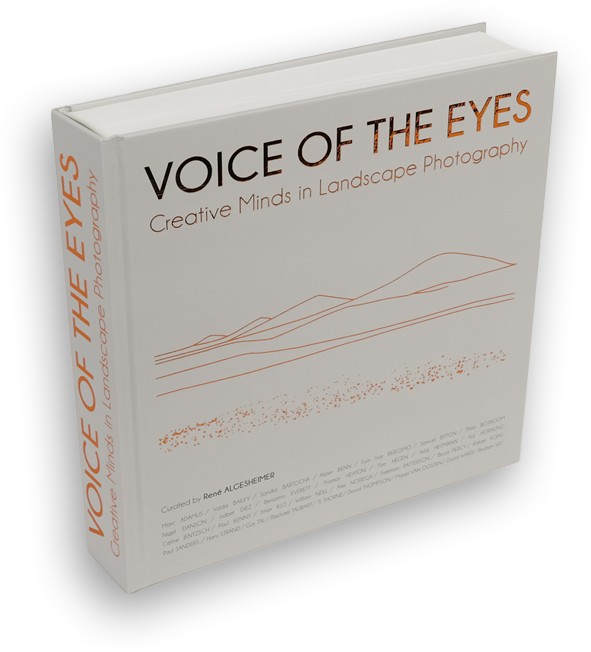
Rafael Rojas interview and landscape photography feature in Voice of the Eyes

Sample Question from the Interview

Please, tell us a personal anecdote that influenced your photographic path.

In 2014, most of my work was focused exclusively on the natural landscape. However, I decided
to submit some of the few images I had made of wildlife to the Master Hasselblad award.
To my surprise, I won. The real award, however, was the outcome of obtaining such a prize. As
one of the Masters, I was supposed to work on a new project related to wildlife, that would be
exposed and part of a book. My initial idea was photographing wildlife in pristine environments.
For some reason, however, I could not accept the idea of doing so, when most of the natural
environments in the planet are under threat and when we are on the brink of the sixth massive
extinction. I decided then to leave completely my comfort zone, and approach a project with
different subject matter, different technique and where a concept would be put in visual terms
by using photography as a metaphor. The project was done in the Natural history museum of
Lausanne, in Switzerland, and became in the end “Dead End”.
This was the first time I would approach something different to landscape, and became truly a
turning point in the way I approached photography. Another turning point, I would say, is less
anecdotic, and was triggered by the completion of an MA in photography.

Discover the Complete Interview with Rafael Rojas

Frequently Asked Questions

Who is Rafael Rojas?

Rafael Rojas is a Swiss-Spanish artist-photographer, author, lecturer, and creativity mentor. He holds an MA in Photography from Falmouth University and received the Master Hasselblad Award in 2014.

What does Rafael Rojas photograph?

His work often addresses concepts such as time, decay and renewal, the interaction between humans and nature, the raw latent energy in the landscape, and the ephemeral qualities of existence.

Does Rafael Rojas consider himself a landscape photographer?

No. Although much of his work happens in the landscape, he explicitly says he does not consider himself a landscape photographer, but a photographer of life.

How does Rafael Rojas develop projects?

He works through both intuitive and project-led approaches. Ideas may emerge in the field, from his archive, or from books, films, music, exhibitions, and other sources, then grow through editing, sequencing, and bookmaking.

Why are books and prints so important in his practice?

He sees presentation as essential to expression. Books, prints, design, sequencing, typography, materials, and handmade construction all contribute to the final meaning of the work.

What printing process is closely associated with Rafael Rojas?

He has devoted nearly a decade to mastering platinum-palladium printing and produces handmade limited edition prints in his own darkroom.

What makes a photograph meaningful for Rafael Rojas?

For him, a strong photograph is anchored in clear intent, coherent with personal vision, linked to lived experience, and capable of carrying concept, symbolism, metaphor, mystery, and emotion.

Explore Voice of the Eyes

Discover interviews, creative perspectives and curated landscape photography from exceptional artists featured throughout Voice of the Eyes.

Explore the Book