Reuben Wu

Reuben Wu matters because he has reimagined what landscape photography can be. His work does not merely document remote places; it reshapes them through artificial light, long exposure, and a visual language that hovers between reality and invention. What makes it distinctive is not a search for fantasy for its own sake, but a desire to reveal something unfamiliar within the world we already inhabit. Landscapes become charged with memory, imagination, and a quiet sense of the improbable. That combination of technical innovation and personal vision gives his work unusual force, and makes his presence in Voice of the Eyes especially resonant.

Reuben Wu’s creative identity is defined by the way he brings together disciplines that are often kept apart. Design, music, photography, sound, technology, and landscape are not separate strands in his practice but parts of a single artistic language. He has said that he sees himself less as a photographer than as an artist who uses photography as one tool among many, and that distinction is crucial to understanding the work.

At the center of his imagery is artificial light on natural landscapes. He is drawn to things that feel slightly strange or out of place, but not in order to escape the real world. Rather, he wants to reveal how compelling our own planet can be when approached through invention and reframing. This is why his images are so often described as otherworldly even though his intention is firmly grounded in the earthly.

Projects such as Lux Noctis, Aeroglyphs, and Ex Stasis make this identity visible in different ways. Lux Noctis illuminates remote landscapes with an invisible drone light source. Aeroglyphs shifts attention to the drone’s light path itself, creating a zero-trace intervention in the landscape. Ex Stasis moves toward hidden textures and more intimate terrain using other light sources. Across these projects, a consistent impulse remains: to create new ways of seeing by combining concept, technology, and atmosphere.

His work is also shaped by the idea of exploration. In a world already over-photographed, Reuben Wu seeks not untouched subject matter but fresh revelation. His images become fragments of memory and imagination, grounded in the world yet transformed by the act of making.

  • Official Website

    Website Reuben Wu 
  • Creative Context

    Chicago, USA

  • Photography Style

    Multidisciplinary visual art rooted in artificial light, long-exposure photography, remote landscapes, and hybrid audiovisual presentation, creating images that feel both believable and estranged.

  • Visual Themes

    Artificial light
    Natural landscapes
    Memory and imagination
    Exploration
    Discovery
    Strangeness
    Remote places
    Light paths
    Hidden textures
    Reality and invention
    Technology and landscape
    Zero-trace intervention

Thoughts Behind the Work

"I always try to create something that feels real, but that at the same time shouldn’t exist."

Photography Approach

Reuben Wu works through a balance of rigorous preparation and active experimentation. Before traveling, he studies locations, routes, and subjects closely in order to reduce pressure and arrive with a strong conceptual foundation. Once on site, however, he remains open to discovery. He has described serendipity as vital to the process: the unexpected conditions, accidents, and visual clues that only appear through direct experience.

This balance is especially clear in Lux Noctis. He knew where he wanted to go and what general idea he wanted to pursue, but much of the series developed through scouting, testing, and learning what kinds of landforms and lighting would work. That process allowed the aesthetic to evolve alongside the concept and the technology itself.

He also thinks beyond the single still image. Narrative, sequencing, sound design, moving image, and final presentation all belong to the project. More recently, he has been combining his own music and sound design with visual work, and developing hybrid frames that merge motion with physical presentation.

What defines his working process most clearly is this co-evolution of concept, aesthetics, technology, and personal development. He prepares carefully, experiments intensely, and lets one project generate the conditions for the next.

Inside Voice of the Eyes

Reuben Wu’s conversation reveals an artist for whom photography is inseparable from exploration. One of the clearest insights in the interview is that he does not see discovery as merely geographic. In a world already heavily documented, the challenge is no longer just to find new places, but to find new ways of revealing them. That idea runs through the entire exchange.

The interview is also valuable because it makes his visual language unusually legible. He explains that his aim is to create images that feel real and yet should not exist, and that artificial light on the landscape has become the constant in his work. This clarifies why projects like Lux Noctis and Aeroglyphs feel so coherent despite their technical novelty: the technology serves a pre-existing artistic vision rather than defining it.

Readers also gain insight into the broader arc of his practice. He speaks about moving from medium-focused experimentation toward message, and from pure visual language toward a fuller artistic language that includes sound and motion. What emerges is a portrait of an artist building an increasingly complete world rather than a sequence of isolated photographs.

Why Featured in Voice of the Eyes

Reuben Wu belongs in Voice of the Eyes because his work expands the definition of photographic vision without abandoning the photograph itself. He shows how a landscape image can remain rooted in place while also becoming an act of invention, intervention, and atmosphere. That ability to hold reality and imagination together makes his work especially significant.

He also strengthens the publication through the clarity of his interdisciplinary thinking. Photography, music, design, technology, and presentation are all part of a single artistic pursuit in his practice. This gives readers a compelling example of how contemporary visual work can move beyond medium boundaries while staying true to a coherent vision.

Most importantly, his contribution matters because it restores discovery to a world saturated with images. Rather than accepting that every place has already been seen, he insists that meaning can still be found through new forms of looking. That makes Reuben Wu not only visually distinctive, but genuinely relevant to the book’s larger purpose.

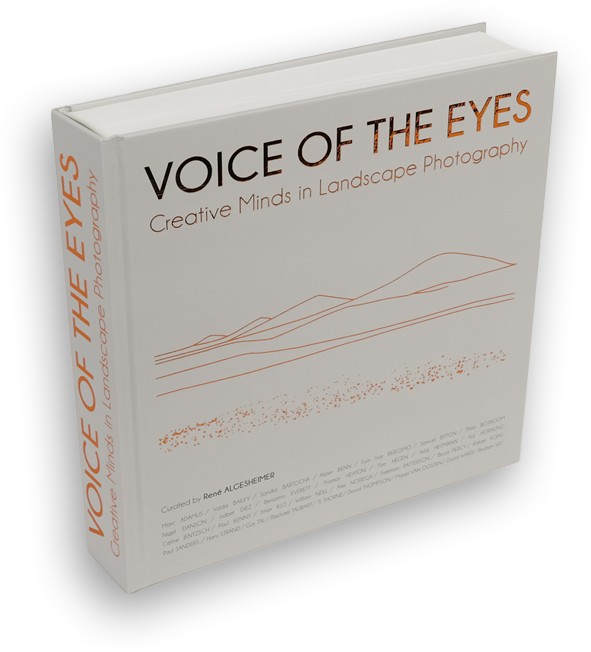
Reuben Wu interview and landscape photography feature in Voice of the Eyes

Sample Question from the Interview

How do you describe your visual language?

I always try to create something that feels real, but that at the same time shouldn’t exist. The idea
of being able to influence lighting in-camera as a creator without relying on digital manipulation
is probably one of my core concepts that has turned out to become a visual language. This is my
attempt at magic. Disembodied light that makes no sense but looks entirely real. This idea originated before I worked with the drone, for example, in my work with expired original Polaroid film in the Arctic Circle, a place where this kind of image shouldn’t exist in the modern-day. In general, I’d say that the constant in my work is artificial light on the landscape.

Discover the Complete Interview with Reuben Wu

Frequently Asked Questions

Who is Reuben Wu?

Reuben Wu is a British multidisciplinary artist, photographer, music producer, and industrial designer originally from Liverpool, UK, who now lives in Chicago, USA.

What is Reuben Wu known for?

He is known for pioneering work with aerial lighting and long-exposure photography, especially projects such as Lux Noctis and Aeroglyphs.

What subjects does Reuben Wu photograph?

His subject matter combines artificial light with natural landscapes, often focusing on remote places, hidden textures, and environments that feel slightly strange or out of place.

What is Lux Noctis?

Lux Noctis is a long-term project in which Reuben Wu uses powerful lights attached to drones to illuminate remote landscapes and create scenes that hover between reality and fiction.

What is Aeroglyphs?

Aeroglyphs is a project based on capturing drone flight paths through long exposures, creating temporary light drawings that leave no physical trace on the landscape.

How does Reuben Wu develop his projects?

He combines extensive research and planning with experimentation and serendipity on location, allowing concepts, aesthetics, technology, and personal development to evolve together.

Does Reuben Wu work only with still photography?

No. He has increasingly expanded his practice into audiovisual works that combine his visual imagery with sound design, music, motion, and hybrid presentation formats.

Explore Voice of the Eyes

Discover interviews, creative perspectives and curated landscape photography from exceptional artists featured throughout Voice of the Eyes.

Explore the Book