Tom Hegen

Tom Hegen’s photographs invite viewers to reconsider landscapes that are often taken for granted. Working from an aerial perspective, he reveals how human activity shapes the earth’s surface, transforming environmental change into visually compelling compositions. His images balance documentary observation with abstraction, presenting familiar places from viewpoints that make patterns, scale, and intervention visible in unexpected ways. By combining the principles of communication design with the descriptive power of photography, Hegen creates work that encourages closer attention to the relationship between people and the environments they inhabit. His contribution is particularly relevant in conversations about landscape, responsibility, and contemporary environmental change.

At the center of Tom Hegen’s work is an interest in understanding how humans shape the earth. His photography is closely connected to the concept of the Anthropocene, a term describing the increasing influence of human activity on biological, geological, and atmospheric processes. Rather than seeking untouched nature, he focuses on landscapes where evidence of human intervention is visible and measurable.

A recurring aspect of his work is the examination of scale. Through aerial photography, Hegen reveals patterns, structures, and relationships that often remain hidden from ground level. His images make visible the dimensions of human activity while encouraging viewers to reconsider environments that may otherwise appear ordinary. This shift in perspective allows familiar places to become visually and conceptually unfamiliar.

Abstraction also plays an important role in his photographs. He frequently presents landscapes in ways that require viewers to decode what they are seeing, creating a deeper engagement with the subject matter. At the same time, he employs aesthetic qualities such as symmetry, color, and graphic structure to establish a connection between viewer and image.

His projects are typically organized around clearly defined topics and developed over long periods. Research, planning, execution, and evaluation form the foundation of his practice. Across exhibitions, books, and photographic series, he combines documentary observation with a visual language rooted in communication design, creating work that explores the visible relationship between people and the environments they transform.

  • Official Website

    Website Tom Hegen 
  • Creative Context

    Germany

  • Photography Style

    German aerial photographer and designer focused on documenting human influence on landscapes through aerial perspectives, abstraction, visual storytelling, graphic compositions, and strong color contrasts.

  • Visual Themes

    Anthropocene
    Human impact on landscapes
    Environmental transformation
    Aerial photography
    Visual storytelling
    Human intervention in natural spaces
    Landscape change
    Communication design
    Scale and perspective
    Documentary observation

Thoughts Behind the Work

"I document the impact of humans on our natural world by fine art aerial photography."

Photography Approach

Tom Hegen’s photographic process begins long before a camera is used. His projects are research-driven, requiring substantial preparation before production starts. He investigates subjects, studies locations, and develops a clear understanding of the conditions under which photographs will be made. This preparation is especially important because many of his projects involve aerial photography using helicopters, airplanes, or heavy-lift drones.

When working from the air, he first seeks an overview of the landscape before identifying potential compositions. The ability to move through three-dimensional space allows him to search for viewpoints that reveal structures, patterns, and relationships within a location. During image-making, he focuses heavily on composition, often making rapid decisions while photographing.

Hegen describes his workflow as a four-step process consisting of research, concept, execution, and evaluation. Individual photographs are selected not only for their visual qualities but also for their contribution to a larger narrative. Images must function independently while also supporting the broader story of a project.

Consistency is another important element of his approach. He considers color relationships, light, composition, distance, and viewpoint when building a series. Presentation is equally significant. Whether the work appears in a book, exhibition, or online environment, he adapts it to the medium while maintaining a coherent visual language through design elements such as layout, typography, and structure.

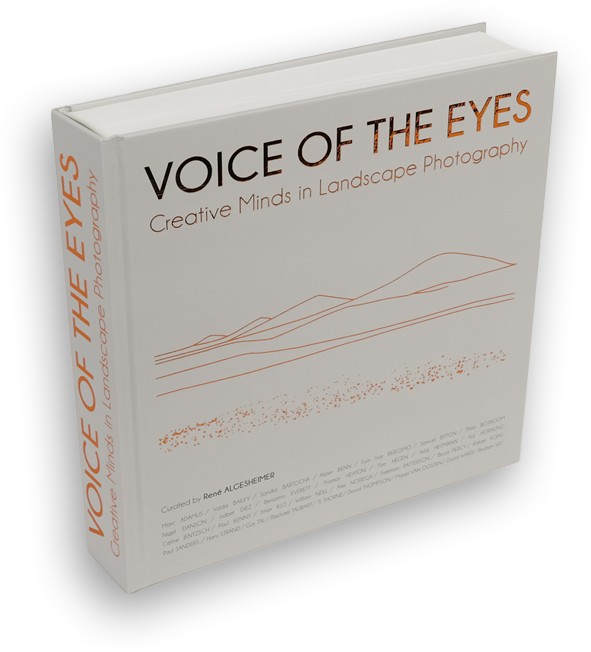
Inside Voice of the Eyes

Tom Hegen’s conversation in Voice of the Eyes provides insight into how communication design influences a photographic practice. Rather than discussing photography solely as image-making, he presents it as a form of visual communication capable of directing attention toward subjects that might otherwise remain unnoticed.

Readers learn how his understanding of landscape evolved from traditional landscape photography toward documenting places shaped by human activity. The interview reveals how aerial perspectives make the scale of human intervention visible and why abstraction can help viewers engage more deeply with environmental subjects. He explains how visual storytelling, research, and preparation contribute to the development of meaningful long-term projects.

The conversation also offers insight into project construction, image selection, and presentation. Hegen discusses the importance of coherence within a body of work and the role that books, exhibitions, and other formats play in connecting images with audiences. Throughout the interview, photography emerges not simply as documentation but as a visual language capable of communicating complex ideas through carefully structured imagery.

Why Featured in Voice of the Eyes

Tom Hegen is featured in Voice of the Eyes because his work contributes a distinctive perspective on contemporary landscape photography. By focusing on environments shaped by human activity, he expands the discussion beyond traditional representations of landscape and encourages viewers to consider the visible consequences of human presence on the earth’s surface.

His contribution aligns closely with the publication’s interest in photographers who combine strong visual work with thoughtful reflection on process, purpose, and communication. The interview demonstrates how photography can function simultaneously as observation, documentation, and visual storytelling. Through aerial perspectives, research-driven projects, and a design-informed approach, Hegen offers insight into how images can communicate complex subjects with clarity and accessibility.

His perspective enriches the broader conversation within Voice of the Eyes by illustrating how photography can reveal relationships between people and landscapes while encouraging sustained engagement with the world around us.

Tom Hegen interview and landscape photography feature in Voice of the Eyes

Sample Question from the Interview

Art is a path to our inner self. What have you found on your path?

It depends on how art is perceived and what role it has in each individual’s life. For myself, who is
a full-time artist, making a living out of it, it is more than only pure inner self-reflection. It is a balance
between sheer freedom and meeting expectations – from myself and others. I turned thirty this year
and consider myself still a fairly young artist with a vision and plenty of ideas for the years ahead.
I’m very grateful that my passion became my job and that it brings great joy to me every day. I
have the feeling that I’m on the right track.

Discover the Complete Interview with Tom Hegen

Frequently Asked Questions

Who is Tom Hegen?

Tom Hegen is a German aerial photographer and designer with a background in visual communication.

What is Tom Hegen known for?

He is known for aerial photography that examines how human activity shapes and transforms landscapes.

What subjects does Tom Hegen photograph?

His work focuses on the Anthropocene, environmental transformation, landscape change, and human intervention in natural spaces.

How does Tom Hegen create his photographs?

He works from helicopters, airplanes, and heavy-lift drones to photograph landscapes from aerial perspectives.

What role does research play in his work?

Research is central to his process. He describes a workflow based on research, concept, execution, and evaluation.

What can readers learn from his Voice of the Eyes interview?

Readers gain insight into his approach to aerial photography, visual communication, project development, and environmental observation.

Which photograph does Tom Hegen highlight in the interview?

He highlights Salt Works II from The Salt Series I as one of his most iconic photographs.

Explore Voice of the Eyes

Discover interviews, creative perspectives and curated landscape photography from exceptional artists featured throughout Voice of the Eyes.

Explore the Book